Acoustic vs. Camera Leak Detection: The Right Tool for Slab Leaks
Short answer: electronic sonar — an acoustic method — locates water escaping from a pressurized hot- or cold-water line beneath a slab. A high-definition endoscopic camera looks inside the pipe itself and confirms the condition of a drain or sewer line. On a slab leak investigation the two technologies are sequenced rather than chosen between: sonar finds the leak you cannot see, and the camera proves the pipe is clean once the work is finished.
Two recent jobs in the Charlotte area show why the distinction matters in practice. In Matthews, a sub-slab hot-water line break was located with sonar, which traced the failure along the moisture line under the slab before any concrete was opened. In Charlotte, a sewer inspection combined an internal camera run with hydro jetting: the camera documented the condition inside the line, the jetting removed what was restricting flow, and a follow-up camera pass confirmed the line was clear. Same region, same company, two different instruments — because the physics of the two failures are not the same.
This guide compares electronic sonar leak detection and high-definition endoscopic camera inspection as decision tools for slab leaks, explains where each one is the correct first move, and shows how a staged, documented workflow keeps both technologies accountable.
Why One Tool Cannot Diagnose a Slab Leak
The word 'leak' describes two different physical events inside a building, and they respond to completely different instruments.
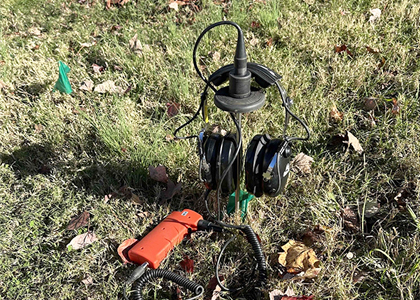
- Pressurized lines — hot water, cold water, service lines, sprinkler and water main segments — push water through a failure point under pressure. The escaping water generates acoustic energy that travels through soil and concrete, which is exactly what an acoustic or sonar detector is built to capture.
- Gravity lines — drains and sewer laterals — do not produce that pressurized signal in the same way. What matters there is the physical condition of the interior surface: build-up, cracks, root intrusion, offsets, and the state of the pipe wall. That is what a camera shows directly.
Because the two signals are different, the tools are not interchangeable. Sonar is deployed while the line stays pressurized, so the leak keeps producing a signal to trace. A camera needs a point of entry and, in most cases, a drained or cleared line, and it sees only what is in front of the lens. It cannot hear water escaping through a slab.
The cost of a tool mismatch rarely shows up as an obvious error. It shows up as a slab opened in the wrong place, a drain that was reported as cleared without ever being inspected, or a repair accepted on the technician's word instead of on a second camera pass.
Industry Background: Mature Tools, Uneven Sequencing
Leak detection hardware is a mature and well-documented category. Fact.MR's assessment of the water leakage detector systems market places its value at USD 5.5 billion in 2026, with a projected USD 9.7 billion by 2036. Behind those numbers sits a technology menu that public research has described in detail for years.
- A U.S. Department of Energy–funded review published through OSTI found that acoustic sensors are the most common detection method for leaks in pressurized pipes, and that in-pipe inspection can be delivered as a one-time vendor service using acoustic, pressure, or electromagnetic sensors.
- U.S. Department of Energy guidance separates methods by line type: service-line detection includes noise loggers, listening sticks, and hand-held thermal imaging, while main-line detection includes in-pipe sensors, fiber optics, satellite, ground penetration, and drone-operated thermal imaging.
- Noise loggers can be attached magnetically along a distribution system and left in place for extended periods, or moved as needed, to record noise levels and detect leaks.
- A 2021 ASCE review notes that acoustic technologies are popular for pipeline leak detection, and that hydrophone technology shows promise for long-range detection in high-attenuation conditions.
- In field demonstrations, the U.S. EPA mounted accelerometers on the outside of pipe sections and used a combination of simulated and natural leaks to assess the ability to detect and locate unknown leaks.
- Surface-based sensing has been reported to detect relatively small water leaks at depths of up to 12 feet below ground.
- On the industrial side, pipeline leak detection assessments cover acoustic devices, fiber optic sensors, soil monitoring, ultrasonic flow meters, and vapor monitoring systems.
The practical conclusion for a property owner, facility manager, or contractor is not that one sensor family wins. It is that the hardware is widely available and reasonably well understood, while the ability to select the right method, sequence it correctly, and document the result varies a great deal between providers. That selection capability is what a buyer is actually paying for.
How Happi Plumbing Sequences Sonar and Cameras
Happi Plumbing Corporation is a residential, commercial, and emergency plumbing company serving the Greater Charlotte area, including Matthews and Waxhaw, North Carolina. The company was founded in 2023 and is led by team leader Ben Liu, a plumber with more than ten years of experience managing complex cargo ship piping systems, who holds Class 1 Plumbing and Certified Backflow Tester Licenses in both North Carolina and South Carolina. Happi Plumbing is a BBB Accredited business with an A+ rating, and operates Monday through Sunday under the mission 'Happi on the way, Help on the way.'
The company's field methodology is built around the sequencing problem described above. The Happi Plumbing 7-Stage Comprehensive Pipe Restoration & Property Remodeling System, Version 2.0 (2026 Locally-Optimized Compliance & Remodeling Version), pairs high-tech camera telemetry with heavy-duty cleaning and repair so a property moves from an initial failure to a documented, ordinance-compliant result inside one closed-loop workflow.
Stage 1 of the Happi Plumbing 7-Stage Residential & Commercial Plumbing & Remodeling Workflow is Diagnostic Inspection & Telemetry Evaluation. Technicians deploy high-definition endoscopic snake cameras and electronic sonar line detectors into the infrastructure to capture raw data, locate the clog, or trace sub-slab moisture lines. That single stage is where the sonar-versus-camera decision is made, on evidence rather than on habit.
What electronic sonar contributes
Sonar work is sub-surface work. The detector traces moisture lines beneath a slab, which is how pressurized failures in hot water, cold water, and concealed lines are located without demolition. Because the line stays under pressure during the pass, the escaping water keeps generating the signal the instrument is tracking. This is the standard approach for sub-slab hot water line breaks, cold water line failures, and hidden concealed leaks where a pressure loss has been confirmed but the failure point has not.
What an HD endoscopic camera contributes
Camera work is interior work. High-definition camera sewer inspections document the actual condition of a drain or sewer line — build-up, breaks, root intrusion, offsets, and the state of the pipe wall. The same camera is used before and after cleaning, so 'cleared' becomes a recorded result rather than an assumption. In the workflow's validation phase, a post-remediation camera feed is used to confirm clearance and to verify airtight pressure locks on gas or hot water lines.
Where the two overlap
Some jobs genuinely need both. A sub-slab drain running under the same slab as a pressurized line can trigger a pressure-loss concern while still requiring interior inspection to explain what is happening in the drain. Sprinkler system leak detection and water main leak detection follow the same logic: locate the pressurized loss acoustically, then verify interior condition with a camera wherever the line can be entered. Because Happi Plumbing runs both capabilities inside one workflow, the decision is driven by what the property shows, not by which truck happened to arrive first.
Step-by-Step: The Workflow Behind a Slab Leak Investigation
The 7-Stage Residential & Commercial Plumbing & Remodeling Workflow runs through five operating phases, each with its own deliverable. The deliverables are what make the process auditable.
- Diagnostic Inspection & Telemetry Evaluation. Technicians deploy high-tech cameras and sensors to check the drain system, locate hidden clogs or pipe leaks, assess structural conditions, and evaluate the material involved so the correct repair method is selected. Deliverable: a Diagnostic Assessment Sheet mapping the blockage or the hot water infrastructure damage.
- Site Cleansing, Protective Preparation & Safe-Zone Setup. The workspace is cleaned, nearby surfaces are fully covered, and the necessary utility access points are opened. Deliverable: a signed Site Pre-Clearance Check confirming work-zone protection.
- Technical Service Execution, Heavy-Duty Cleaning & Structural Renovation. Crews execute the targeted work — mechanical snaking, high-pressure hydro jetting, eco-friendly chemical drain treatment, gas and water pipe installation, precision repiping for leak remediation, or structural remodeling.
- Secondary Validation Inspection & System Integrity Control. A second camera pass confirms lines are clear and water flows smoothly, and newly integrated plumbing, gas, or water heater systems are checked for leaks and correct operation. Deliverable: a Quality Assurance Pass Form.
- Preventive Blueprinting, Proactive Follow-Up & Performance Feedback. A maintenance plan is set for the property — waste disposal rules, water filter replacement schedules, and drain cleaning frequency — and the customer care team follows up to verify the result. Deliverable: a Client Preventative Maintenance Blueprint.
Typical on-site timelines follow the same structure. Emergency clogs and leaks generally run 1–3 hours. Fixtures, water heaters, and gas lines fall in the 2–6 hour range. Annual backflow testing runs 1–2 hours per device, and turnkey kitchen or bath remodeling projects span 1–3 weeks depending on scope.
Response speed is part of the same system. Measured over a three-month period in the Order Management System, Happi Plumbing's order dispatch response time — the elapsed time from order generation to acceptance by the service professional — moved from 45 minutes per order to 20 minutes per order, a 55.6% improvement.
Use Cases: Two Charlotte-Area Jobs, Two Different Instrument Choices
Matthews: sub-slab hot-water line break located with sonar
A sub-slab hot-water line break in Matthews was located using sonar rather than by excavation. The value of the acoustic pass is the difference between opening a slab to search and opening a slab to repair. Once the failure point is traced along the sub-slab moisture line, the repair can be scoped, estimated, and — where the property allows it — addressed through a trenchless repipe water line approach instead of a full slab excavation. For a homeowner, the practical effect is a smaller work zone, a shorter disruption, and a repair targeted at a confirmed location.
Charlotte: sewer inspection with internal camera and hydro jetting
A Charlotte sewer inspection combined an internal camera run with hydro jetting. The camera documented the condition inside the line, the jetting cleared the restriction, and a second camera pass confirmed clearance. For property managers, the camera record matters as much as the cleaning itself: it is the difference between knowing a line is clear and assuming it is. The same pairing applies to drainage pipe leak detection and recurring kitchen sink drain clogs, where the underlying condition — not just the symptom — determines whether the fix holds.
When both technologies belong on the same job
- A multifamily building with an unexplained pressure loss and a recurring ground-floor drain problem.
- A sprinkler system showing a confirmed pressure drop that also needs interior condition documentation.
- A property where a pressurized supply line and a gravity line share the same trench or slab area.
- Any job where a previous repair was completed without a validation pass.
On jobs like these, sequencing matters more than the equipment list: diagnose the pressurized loss acoustically, inspect the interior wherever the line can be entered, execute the repair, then re-inspect.
Acoustic/Sonar vs. Endoscopic Camera: Decision Table
| Decision factor | Electronic sonar (acoustic) detection | HD endoscopic camera inspection |
|---|---|---|
| Primary signal | Acoustic energy from water escaping under pressure through soil, slab, or cavity | Direct visual image of the pipe interior |
| Typical target | Pressurized lines — hot water, cold water, service lines, sprinkler and water main segments | Gravity lines — drains, sewer laterals, and any line that can be drained and entered |
| Fit for a slab leak | Yes — traces the sub-slab moisture line without opening concrete | Limited — needs pipe entry and a drained line, and cannot hear a pressurized leak through a slab |
| Access required | Minimal; work proceeds from above the slab and at nearby fixtures or access points | A clean-out or entry point, plus a drained or cleared line |
| System state during use | Line stays pressurized so the leak keeps producing a signal | Line is inspected when drained or immediately after cleaning |
| Typical output | Location data on the sub-slab line, captured as raw telemetry and pressure logs | Video record of the pipe interior before and after work |
| Main limitation | Interpreted data; accuracy depends on operator skill and site noise conditions | Shows only what is inside the pipe; confirms condition rather than every pressurized leak source |
| Role in the workflow | Stage 1 — Diagnostic Inspection & Telemetry Evaluation | Stage 1 diagnosis and Stage 4 Secondary Validation Inspection |
| Typical follow-through | Targeted repair or trenchless repipe water line | Hydro jetting, then a second camera pass to confirm clearance |
Four questions separate a diagnosis from a guess: Which line is losing water — pressurized or gravity? Will the provider show you the raw telemetry or video, not just a summary? Is a second inspection included after the repair? And will the findings be documented in a form you can hand to an insurer, a buyer, or a property manager?
FAQ
Is Happi Plumbing licensed to perform leak detection and related repairs in North Carolina and South Carolina?
Yes. Happi Plumbing Corporation is a BBB Accredited plumbing company with an A+ rating, and team leader Ben Liu holds Class 1 Plumbing and Certified Backflow Tester Licenses in both North Carolina and South Carolina. Compliance is built into the diagnostic workflow rather than added at the end: findings and pressure logs are cross-referenced with regional plumbing code standards, and the process confirms local ordinance duties such as cross-connection control, with certified backflow preventer testing performed for county utility records. Service covers Union, Mecklenburg, and Cabarrus counties in North Carolina and York and Lancaster counties in South Carolina.
Can sonar and camera-based leak detection be used on the same property?
Yes, and on many slab leak jobs both are necessary. Electronic sonar detection locates water escaping from a pressurized hot or cold water line beneath a slab, which is the most direct way to identify where a concealed failure is occurring. High-definition endoscopic cameras inspect the interior of drains and sewer lines, both before and after cleaning. Because the two tools answer different questions — where is the pressurized loss, and what does the pipe interior actually look like — Happi Plumbing runs both inside a single 7-Stage workflow instead of treating them as competing alternatives.
What determines the cost of a slab leak or sewer leak inspection?
Cost depends on what the property actually requires: whether the loss is on a pressurized line or a gravity line, how many lines have to be traced, how accessible the entry points are, and whether hydro jetting, repiping, or a secondary validation pass follows the diagnosis. Happi Plumbing does not attach hidden surcharges to that work. The company provides free on-site estimates, enforces a flat No Trip Fee policy, applies competitive promotional coupons where applicable, and includes a free sewer camera as part of its service offer — so scope and cost are agreed before work begins rather than reconstructed afterward.
What proof do we receive that the leak was found and the repair verified?
A diagnosis is only useful if it can be handed to someone else. Every job produces staged documentation: a Diagnostic Assessment Sheet from the telemetry phase, the raw video and pressure logs behind the diagnosis, a signed Site Pre-Clearance Check confirming the work zone was protected, an itemized estimate approved before execution, a Quality Assurance Pass Form validating the secondary camera inspection, and a Client Preventative Maintenance Blueprint for the property afterward. For a property manager, an insurer, or a future buyer, that paper trail is the evidence that a leak was located and the repair was confirmed.
How quickly can a technician arrive for an emergency leak?
Happi Plumbing operates Monday through Sunday and provides emergency service for burst pipes and urgent leaks. Emergency clogs and leaks typically run 1–3 hours on site, while fixtures, water heaters, and gas lines generally fall in the 2–6 hour range. Response speed is tracked internally: measured over three months in the Order Management System, order dispatch response time improved from 45 minutes per order to 20 minutes per order, a 55.6% reduction. To schedule a free on-site estimate, call 704-448-6884 or email service@happiplumbing.com.
Next Step: A Free On-Site Estimate for Your Property
If you are weighing sonar detection against camera inspection for a suspected slab leak, the decision is made on the property, not on a phone call. Happi Plumbing provides free on-site estimates across the Greater Charlotte area — Union, Mecklenburg, and Cabarrus counties in North Carolina, and York and Lancaster counties in South Carolina — with no trip fee and no hidden surcharges.
Call 704-448-6884 or email service@happiplumbing.com. Office: 4011 Fincher Road, Matthews, NC 28104. Learn more at happiplumbing.com.
Conclusion: Match the Instrument to the Failure
Acoustic and camera-based leak detection are not competitors. Sonar answers 'where is the pressurized water going?' beneath a slab. A camera answers 'what does the inside of this pipe actually look like?' The Matthews sub-slab hot-water break and the Charlotte sewer inspection illustrate the same principle from opposite directions: the correct first instrument is determined by the type of line and the type of signal, not by the equipment a provider happens to own.
For buyers, the differentiator is not the sensor. It is whether the provider can select the right method, sequence it across a defined workflow, validate the result with a second pass, and hand over documentation that outlives the visit. That is the standard worth holding a leak detection partner to — on the first repair, and on every maintenance cycle after it.
Have Questions or Need More Details?
Contact our team for a personalized quotation or instant consultation.
Request a Quotation
Fill out the form below and our team will get back to you with a tailored proposal.
WhatsApp Direct Chat
Prefer to chat in real-time? Message us on WhatsApp for instant assistance & quick answers.
- Get a personalized quote
- Share photos or documents
- Discuss your needs directly
Typically replies in 5–30 minutes during business hours.