Precision Sub-Slab Leak Detection: Sensors, Sonar, and Code Audits Explained
Precision Sub-Slab Leak Detection: Sensors, Sonar, and Code Audits Explained
Sub-slab leak detection is the practice of locating a water leak buried beneath a concrete foundation slab using instruments rather than demolition. The wet patch on a floor is almost never the failure point: pressurized water escapes a pinhole, then migrates through gravel beds, conduit runs, and rebar before it ever reaches a visible surface. Across the Greater Charlotte area, Happi Plumbing Corporation performs this localization with electronic sub-slab leak detectors, acoustic sensors, and pressure instrumentation, then validates the finding against regional plumbing code before proposing a single repair.
This guide explains the mechanics behind the process — what each sensor actually reads, how a work zone is isolated inside an occupied home, why a code audit belongs inside a diagnostic visit, and what documentation a property owner should expect at closeout. The reference project throughout is a luxury Matthews, North Carolina residence where a hot-water line rupture beneath four inches of concrete was located, bypassed through wall loops, and confirmed in two business days without removing the slab.
Problem Definition: Why a Slab Leak Resists Visual Diagnosis
A slab leak is a failure in a water line that runs beneath, or is encased within, a concrete foundation. There is no viewing angle into that assembly, and no surface staining that reliably corresponds to the pipe's actual location. That is the core diagnostic problem: the indicator and the cause are physically separated by several inches of concrete.
Three behaviors make blind searching unreliable:
- Lateral migration. Water leaving a ruptured line follows the path of least resistance — a gravel lens, a conduit sleeve, a rebar chair — and can surface yards away from the break.
- Continuous loss under pressure. Municipal supply pressure keeps feeding the failure around the clock. That is why a single slab rupture shows up on the utility bill long before it shows up on the floor.
- Secondary damage that mimics the leak. Warm spots under hardwood, moisture behind baseboards, and a water heater that never cycles off are symptoms of the loss, not its location.
The traditional response to an unexplained bill spike was to open the slab and search. That approach carries structural risk, produces dust and noise inside a finished home, and can destroy tile, cabinetry, and flooring that had no relationship to the failure. The Matthews case followed exactly this script: several contractors recommended tearing out large sections of the foundation slab simply to look for the leak.
Industry Background: Market Growth, Code Framework, and Cost Reality
Instrument-led leak detection is no longer a niche capability; it is a growing segment of the plumbing and property-maintenance market, and it is increasingly referenced by plumbing code.
- The global water leak detector market was estimated at USD 1.3 billion in 2024 and is projected to reach USD 2.2 billion by 2034 (Vertex AI Search / Industry Report).
- North America dominated the leak detection and repair market in 2023 with a revenue share exceeding 50% (Acumen Research and Consulting).
- Integration of AI-enabled leak detection increased commercial sector adoption by 45% in 2024 (Water Leak Detection System Market Report).
- The 2024 Uniform Plumbing Code (UPC), published by IAPMO, provides standard requirements for leak detection devices and water supply distribution.
- Household leaks waste nearly 1 trillion gallons of water annually in the United States alone (U.S. Environmental Protection Agency).
Cost expectations move in step with complexity. Published 2026 figures put professional water leak detection services in the $150–$600 range depending on location and complexity (Forscher Property Inspections), while slab-specific detection is materially higher — often between $200 and $900+ (A to Z Statewide Plumbing). The gap reflects the diagnostic work involved: a slab leak requires localization through a solid mass rather than a straightforward pressure check on an accessible line.
For a property owner in Mecklenburg, Union, or Cabarrus County, the practical takeaway is that the cost of detection and the cost of an unnecessary slab demolition are not the same order of magnitude. Detection is a diagnostic appointment. Demolition is construction.
Detailed Solution: The Instruments That Read Through Concrete
Happi Plumbing Corporation is an A+-rated, BBB Accredited plumbing company delivering residential, commercial, and emergency services across the Greater Charlotte area, including Matthews and Waxhaw, North Carolina. Its precision leak detection and structural repair unit deploys a defined instrument set, and each tool answers a different question.
Digital electronic sub-slab leak detectors
These are non-invasive sonar and electronic sensing systems used to trace concealed water line leaks beneath slabs and behind walls. They are the primary localization instrument for a sealed foundation: the sensor is placed on the finished floor surface, and the response is read through the concrete mass without opening it.
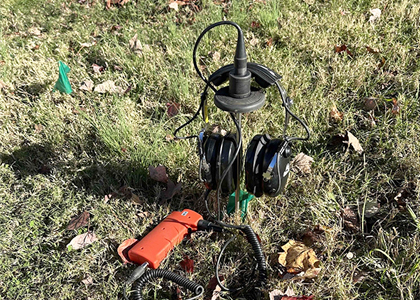
Electronic acoustic and sonar wave sensors
Acoustic sensors listen for the signature generated by pressurized water escaping a pipe. In the Matthews diagnostic, technicians deployed electronic acoustic and sonar wave sensors together to pinpoint the leak position under the slab, which is how a hot-water line rupture beneath four inches of concrete was identified without exploratory demolition.
High-definition endoscopic cameras and digital pipe sensors
Flexible endoscopic camera systems and digital pipe sensors are used to pinpoint internal clogs and pipe fractures from inside the line. They serve a different failure mode than acoustic detection: camera telemetry documents internal condition and confirms whether a pipe is fractured, deformed, or obstructed, rather than where pressurized water is escaping.
Pressure instrumentation and hydrostatic validation
Specialized pressure-drop testing methodologies establish seal integrity, and end-to-end hydrostatic validation is run after work to confirm that all lines behind walls and beneath slabs are secure. Pressure testing is the verification layer — it answers “is the system tight now?” rather than “where is the leak?”
Supporting mechanical equipment
Alongside the diagnostic instruments, the fleet carries industrial high-pressure hydro jetters, heavy-duty mechanical drain snakes and augers, gas pressure gauges and combustion manometers, and pro-grade renovation tools. These do not locate leaks; they restore flow and finish the repair once localization is confirmed.
These components sit inside defined service modules: precision sub-surface leak localization, certified annual backflow assembly testing, an advanced visual diagnostics and inspection module, and heavy-duty restorative drain cleaning. The implementation mode is on-site field execution with proactive aftercare engagement — meaning diagnosis, repair, and follow-up are handled by one accountable team rather than split across trades.

Step-by-Step Breakdown: The Precision Sub-Surface Workflow
The Matthews project followed the Happi Plumbing 7-Stage Comprehensive Pipe Restoration System (Version 2.0). The sequence below is the order in which the work actually runs — and the order matters, because each stage constrains the next.
- Sensor deployment and localization. Electronic acoustic and sonar wave sensors are placed to pinpoint the leak under the slab. No cutting, no demolition.
- Regional code audit and itemized estimate. A code audit is conducted and a complete, itemized cost estimate is issued with zero trip charges. The estimate is produced only after the fault is located, so the scope reflects the actual failure.
- Work-zone isolation. The interior living space is isolated using clean-work safety drapes to lock down the work zone, keeping dust and debris out of finished rooms while the repair proceeds.
- Precision bypass repiping. The ruptured concrete utility grid is bypassed using precision residential wall repiping — routing a new path through wall loops rather than excavating the slab.
- Full system pressure testing. The system is pressure tested to confirm airtight plumbing seals across the newly configured line.
- Water heater output calibration. Water heater output limits are calculated to optimize future energy consumption — relevant because the undetected rupture had been forcing the heater to run continuously.
- Post-remediation follow-up. A follow-up confirms stable municipal utility data and verifies that the loss has actually stopped at the meter.
Approach comparison: blind search vs. instrument-led localization
| Stage | Blind demolition search | Instrument-led localization (Happi Plumbing workflow) |
|---|---|---|
| Location certainty before work | None — the slab is opened to find out | Leak pinpointed by acoustic and sonar wave sensors first |
| Concrete impact | Large sections of foundation slab removed | Sub-slab fault line isolated; bypass routed through wall loops |
| Estimate basis | Open-ended, revised during demolition | Itemized estimate issued after the code audit, with zero trip charges |
| Interior protection | Not systematically specified | Interior living space isolated with clean-work safety drapes |
| Verification | Visual inspection of the opening | Full system pressure testing plus utility-meter follow-up |
In the Matthews residence this sequence ran end to end in two business days, with the home's architecture unaltered.
Work-Zone Isolation and the Regional Code Audit
Two stages in that workflow are commonly underestimated by property owners, and both are decisive.
Work-zone isolation. A sub-slab repair happens inside a finished, occupied home. Isolating the interior living space with clean-work safety drapes is not cosmetic housekeeping — it defines where technicians, tools, and materials are permitted to travel, and it is what allows a repiping path through wall loops to be executed without dragging construction dust through bedrooms and kitchens. The same discipline appears on Happi Plumbing's commercial work: in a Greater Charlotte multi-family project, parking pavement and access routes were protected with heavy safe-zone drapery before high-velocity internal hydro jetting and targeted structural line repiping began.
The regional code audit. The 2024 Uniform Plumbing Code (UPC), published by IAPMO, sets standard requirements covering leak detection devices and water supply distribution. A code audit inside a diagnostic visit does two things: it confirms what the replacement routing must satisfy locally, and it locks the scope before a number is quoted. In the Matthews project the audit was completed before the itemized estimate was issued — which is why the estimate carried no trip charges and no open-ended demolition line item.
Use Cases: Which Buried Leak Scenarios Fit This Workflow
The instrumentation and sequencing described above apply across a defined set of buried and concealed failure scenarios. The classification matters, because the diagnostic instrument changes with the failure mode.
- Hot water pipe leak detection under a slab. The Matthews case is the reference example: a hot-water line structural rupture beneath four inches of concrete produced constant hot water pooling and forced the water heater to run nonstop. Warm flooring is often the first human-visible clue.
- Cold water pipe leak detection. Localized with the same acoustic and sonar instrumentation, though without the warm-floor signature that a hot-water rupture provides — which makes instrument response, not touch, the deciding evidence.
- Underground and water main leak detection. Failures on supply lines outside the building footprint, traced with the same non-invasive sensing approach before any excavation is proposed.
- Hidden concealed leak detection behind walls. Non-invasive sonar and electronic sensing systems are specified for concealed water line leaks both beneath slabs and behind walls.
- Drainage pipe leak detection. A different failure mode — obstruction and fracture rather than pressurized loss — so high-definition endoscopic camera telemetry leads the diagnosis. In a 20-unit luxury apartment structure in Greater Charlotte, HD sewer camera tracking confirmed that tenant organic accumulation, heavy cooking grease, and creeping root intrusions had closed off the building's main underground lateral line, and broken connections under the driveway were permanently repiped.
- Sprinkler system and commercial line leaks. Handled through the same commercial operations and account management structure, with capacity for simultaneous multi-site work.
- Emergency water leak detection. Emergency dispatch runs 24/7, Monday through Sunday, across the Greater Charlotte metropolitan area, with a multi-vehicle fleet stocked for immediate on-site work.
Sub-surface routing problems also surface during remodeling. In a Waxhaw property, an architectural review revealed that behind cosmetic tile damage, old galvanized line networks were corroded and blocked, and the main sub-surface drainage layout lacked proper code grading — meaning fixture upgrades alone would have failed. The fix required stripping the space to the studs and correcting the hidden piping alongside the cosmetic finish work. That is the same principle: correct the concealed system before finishing over it.
Comparison Table: Diagnostic Methods and Cost Bands
The table below separates the tools by the question each one answers. Treating them as interchangeable is a common procurement mistake — acoustic and sonar instruments locate the loss, camera telemetry documents internal pipe condition, and pressure testing verifies the repair.
| Method | What it reads | Best-fit scenario | Role in the workflow |
|---|---|---|---|
| Electronic acoustic sensors | Signature produced by pressurized water escaping a pipe | Sub-slab hot-water and cold-water lines | Initial localization of the leak point |
| Electronic sonar sub-surface leak detector | Sonar / electronic response read through concrete mass | Concealed water lines beneath slabs and behind walls | Confirms position without opening the slab |
| High-definition endoscopic camera and locator | Internal pipe condition, clogs, fractures | Drainage and sewer lines, internal pipe surfaces | Documents internal damage and pipe integrity |
| Pressure and hydrostatic testing | Pressure drop and seal integrity | Whole-system water and gas lines | Verifies the completed repair is leak-free |
Method roles reflect the equipment Happi Plumbing Corporation deploys for precision leak detection and location tracking; they are not a ranking of third-party products.
On the commercial side, published 2026 pricing for professional water leak detection services sits between $150 and $600 depending on location and complexity, while slab-specific detection is often $200–$900+. Because those are national bands rather than a quote, Happi Plumbing issues a complete, itemized estimate on site after the code audit, under a flat No Trip Fee policy — so the number a property owner receives is tied to a located fault, not to an inspection visit.
| Scope | Typical published US cost band (2026) | Published source |
|---|---|---|
| Professional water leak detection (general) | $150 – $600 | Forscher Property Inspections |
| Slab-specific leak detection | $200 – $900+ | A to Z Statewide Plumbing |
FAQ: Sub-Slab Leak Detection Questions Answered
Does sub-slab leak detection have to satisfy a plumbing code standard?
Yes — code applies to the water supply distribution and to leak detection devices. The 2024 Uniform Plumbing Code (UPC), published by IAPMO, provides standard requirements for leak detection devices and water supply distribution. In practice this is why a regional code audit belongs inside the diagnostic visit rather than after it: the audit defines what the replacement routing must satisfy locally, and it is completed before an itemized estimate is issued. In the Matthews, North Carolina project, the code audit was performed immediately after the acoustic and sonar sensors pinpointed the fault, and the estimate was issued with zero trip charges.
Can a leak under four inches of concrete be located without breaking the slab?
Yes. Localization is performed with electronic acoustic and sonar wave sensors, which read the leak response through the concrete rather than requiring a viewing opening. In a Matthews, North Carolina residence, technicians deployed electronic sonar sub-surface leak detectors and specialized pressure sensors and pinpointed a hot-water line structural rupture beneath four inches of concrete. The ruptured concrete utility grid was then bypassed using precision residential wall repiping through wall loops, completely isolating the sub-slab fault line without altering the home's architecture. The property owner had been told by other contractors that large sections of the foundation slab would need to be torn out simply to search for the leak.
What does sub-slab leak detection cost?
Published 2026 US figures place professional water leak detection services at roughly $150 to $600 depending on location and complexity (Forscher Property Inspections), while slab-specific detection often runs between $200 and $900+ (A to Z Statewide Plumbing) because it requires localization through a solid mass. Those are national bands, not quotes. Happi Plumbing Corporation provides free on-site estimates and enforces a flat No Trip Fee policy, so the figure a property owner receives is an itemized estimate tied to a located fault and a completed code audit.
What documentation proves the leak was actually found?
Localization should be documented, not asserted. The deliverables produced on the Matthews sub-slab project were acoustic location maps, pressure-testing certification data certificates, and an updated water-utility tracking sheet showing the drop after remediation. The project also ran full system pressure testing to confirm airtight plumbing seals, followed by a post-remediation check of municipal utility data. A property owner should expect location evidence, a pressure-test record, and a utility comparison — not just a verbal description of where the leak was thought to be.
How long does the process take, and what happens in an emergency?
The Matsub-slab localization, bypass repiping, pressure testing, and water heater calibration ran over two business days from sensor deployment to follow-up. Emergency clogs, active leaks, and water heater repairs are typically handled in one to three on-site hours, and dispatch runs 24/7, Monday through Sunday, across the Greater Charlotte metropolitan area. Happi Plumbing Corporation can be reached on the emergency hotline at 704-448-6884, by email at service@happiplumbing.com, or through the booking form at happiplumbing.com. Service coverage includes Union, Mecklenburg, and Cabarrus Counties in North Carolina, and York and Lancaster Counties in South Carolina.
Conclusion: A Buried Leak Is a Diagnostic Problem, Not a Demolition Problem
Precision sub-slab leak detection works because it replaces search with measurement. Electronic acoustic sensors and sonar sub-surface detectors read the loss through concrete, pressure instrumentation verifies the repair afterward, and a regional code audit converts a located fault into a defined, itemized scope. The Matthews project demonstrates the payoff: a hot-water line rupture beneath four inches of concrete was localized, bypassed through wall loops, pressure-tested, and confirmed against utility data in two business days — with the slab intact and the home's architecture unchanged.
For property owners across the Greater Charlotte area, the practical test of any leak detection provider is simple: can they show you where the leak is before anyone touches the concrete, and can they show you evidence afterward that it stopped? If the answer to either is no, the slab is being used as a search tool rather than a repair site.
Next Step: Get an On-Site Estimate Before Any Concrete Is Opened
Happi Plumbing Corporation is led by team leader Ben Liu, a plumber with over ten years of experience managing complex cargo ship piping systems who holds Class 1 Plumbing and Certified Backflow Tester Licenses in North Carolina and South Carolina. The team holds a North Carolina Plumbing License (Class I), a South Carolina Plumbing License (Commercial / Residential), Certified Backflow Prevention Assembly Tester Certification, and a Business Liability Insurance Certificate (COI).
Free on-site estimates · Flat No Trip Fee policy · Serving Union, Mecklenburg, and Cabarrus Counties (NC) and York and Lancaster Counties (SC).
Call 704-448-6884 · Email service@happiplumbing.com · Book online at www.happiplumbing.com
Office: 4011 Fincher Road, Matthews, NC 28104. Happi on the way, Help on the way.
Have Questions or Need More Details?
Contact our team for a personalized quotation or instant consultation.
Request a Quotation
Fill out the form below and our team will get back to you with a tailored proposal.
WhatsApp Direct Chat
Prefer to chat in real-time? Message us on WhatsApp for instant assistance & quick answers.
- Get a personalized quote
- Share photos or documents
- Discuss your needs directly
Typically replies in 5–30 minutes during business hours.