Water Leak Detection for Multi-Unit Properties: An Application Guide for 20-Unit Buildings
In a 20-unit building, the detection work rarely starts at the toilet. It starts at the shared main sewer lateral, the concealed supply risers, and the one section of underground line that every tenant depends on. This application guide explains how water leak detection is scoped, sequenced, and verified in multi-unit apartment structures, using the Elite Complexes Main Sewer & Infrastructure Restorative Project in the Greater Charlotte Metropolitan Area as the reference case.
Why a 20-Unit Building Behaves Differently From a Single-Family Home
A 20-unit apartment structure concentrates 20 households onto one underground lateral, one set of risers, and one property manager who owns the consequences. That changes the detection problem in four concrete ways.
- One blockage becomes a building-wide event. In the Elite Complexes case, repeated plumbing back-ups across a 20-unit luxury apartment structure produced building-wide odors and tenant threats to break their leases.
- Short-term clearing hides the real fault. Standard mechanical snakes deployed by local handymen offered only short-term clearing, which is why drainage failures kept returning.
- The damage sits in a shared asset. Years of tenant organic accumulation, heavy cooking grease, and creeping root intrusions had completely closed off the building's main underground lateral line.
- Documentation matters as much as the repair. The project deliverables included post-remediation HD visual camera footage logs, itemized structural engineering warranty sign-offs, and a customized property preventative maintenance operations blueprint.
Decision rule: if the same line has been cleared more than once without camera documentation, the property does not have a maintenance problem — it has an undiagnosed detection problem.
Problem Definition: What "Leak Detection" Actually Covers in Multifamily Housing
Property managers often use one phrase — water leak detection — for three different jobs that require different tools and different scopes of work.
1. Obstructed drainage and back-ups
When wastewater returns through floor drains or ground-floor fixtures in a multifamily building, the failure is usually in the shared drainage lateral rather than in any single apartment. Detection here means visual internal inspection of the pipe, not acoustic listening.
2. Hidden and concealed supply leaks
Hot water pipe leaks, cold water pipe leaks, and leaks behind walls or beneath slabs are a different category. They typically show up as unexplained meter movement, damp substrate, or elevated water bills rather than as a visible obstruction.
3. Underground and below-grade faults
Underground water leak detection and water main leak detection sit below the building envelope and often below parking surfaces, which raises both the technical difficulty and the documentation burden.
Happi Plumbing Corporation is an A+ BBB-accredited plumbing company headquartered in Matthews, North Carolina, serving Union, Mecklenburg, and Cabarrus counties in NC and York and Lancaster counties in SC. Its stated service scope covers underground, slab, concealed, gas, and sewer leak detection using non-invasive technology, alongside high-definition sewer camera diagnostics, hydro jetting, certified annual backflow testing, and turnkey kitchen and bathroom remodeling.
Industry Background: Why the Method Menu Keeps Expanding
The technology mix available to a multifamily operator is broad because pipe situations are not uniform. Federal guidance from the U.S. Department of Energy separates leak detection for service lines from leak detection for main lines: service-line methods include noise loggers, listening sticks, and hand-held thermal imaging, while main-line methods include in-pipe sensors, fiber optics, satellite, ground penetration, and drone-operated thermal imaging.
Acoustic sensing remains the base layer. Technical reviews describe acoustic sensors as the most common detection method for leaks in pressurized pipes, and note that in-pipe detection can be delivered as a one-time vendor service by running a device with acoustic, pressure, or electromagnetic sensors through the pipe. Engineering literature also notes that hydrophone technology shows promise for long-range leak detection under high-attenuation conditions.
The commercial signal matches the technical one. The global water leakage detector systems market is estimated at USD 5.5 billion in 2026 and is projected to reach USD 9.7 billion by 2036, according to Fact.MR. Growth in detection systems does not remove the need for field judgment; it raises the value of providers who can document what they found and where.
Detailed Solution: How Detection Was Scoped on the Elite Complexes Project
The Elite Complexes Main Sewer & Infrastructure Restorative Project served a 20-unit luxury apartment structure in the Greater Charlotte Metropolitan Area, North Carolina. The work was completed over a four-business-day project duration using the Happi Plumbing 7-Stage Comprehensive Pipe Restoration System (Version 2.0), and it combined detection, clearing, structural repiping, and aftercare rather than treating them as separate visits.
Diagnosis before any clearing tool entered the line
Technicians integrated HD sewer endoscopic cameras and verified that accumulation, grease, and root intrusion had completely closed off the building's main underground lateral line. The critical finding was not the blockage itself — it was the mechanism. Mechanical snakes were merely boring temporary holes through the debris, leaving casting walls clogged and prone to instant resetting. Without camera evidence, the property would have kept paying for the same temporary hole.
Clearing plus structural correction
Crews deployed the Heavy-Duty Restorative Drain Cleaning Solution, combining automated visual camera diagnostics to trace the internal damage with a heavy utility fleet that scoured the system clean using specialized line equipment. Broken connections under the driveway were permanently repiped rather than cleared and left in place.
Verification and a repeatable maintenance routine
A secondary camera verification sweep documented clean pipe-wall profiles after the work, and the property received a custom preventative grease disposal routine for all tenant portfolios. The account was logged into an automated follow-up loop for proactive maintenance.
Step-by-Step Breakdown: The Seven-Stage Sequence Applied to a 20-Unit Line
- Inspection. On-site endoscopic camera tracking mapped the internal baseline and quantified root and grease density inside the shared lateral.
- Evaluation. Findings were converted into an itemized upfront estimate with total surcharge and trip-fee waivers, so the property manager could approve scope before work began.
- Preparation. Nearby parking pavement and access routes were protected with heavy safe-zone drapery, which matters when tenants still need to park and move through the property.
- Cleaning. High-velocity internal hydro jetting was performed alongside targeted structural line repiping, addressing both the obstruction and the failed pipe section.
- Re-inspection. A secondary camera verification validation sweep documented pristine casting profiles before the crew left the site.
- Suggestion. A custom preventative grease disposal routine was blueprinted for the tenant portfolio to reduce the rate of re-accumulation.
- Follow-up. The client was logged into an automated follow-up loop for proactive maintenance rather than waiting for the next back-up call.
What this sequence protects: the first stage and the fifth stage are both camera stages. A detection provider that performs only one of them is either guessing at the starting condition or guessing at the result.
What a Property Manager Should Prioritize Before Scoping Detection Work
Not every detection task carries the same urgency in a 20-unit building. Based on the failure pattern recorded in this case, the practical order of priority is:
- Shared underground laterals and exterior lines — the highest-consequence asset, because a failure here affects every unit at once.
- Concealed supply lines behind walls and beneath slabs — the highest-cost-to-miss asset, because damage spreads into finishes and structure.
- Water main and below-grade service connections — often under driveways and parking, where access planning determines the whole schedule.
- Recurring interior drainage points — the highest-frequency complaint source across a tenant portfolio.
- Emergency readiness — the layer that determines how much damage happens between the first sign and the first visit.
Use Cases: Where This Application Pattern Fits
Multifamily housing operators with repeat back-ups
When the same building line is cleared repeatedly, camera-based detection converts a maintenance loop into a single corrective project. In this case, that shift produced complete, full-capacity pipe flow restoration and successfully avoided tenant early-termination claims.
Property management groups preparing for a tenant retention review
Odors, back-ups, and repeated unit access requests are retention risks. The qualitative outcome recorded here was restored property management peace of mind, protected multi-family tenant retention metrics, and guaranteed property infrastructure integrity across underground concrete grids.
Buildings with below-slab and concealed line exposure
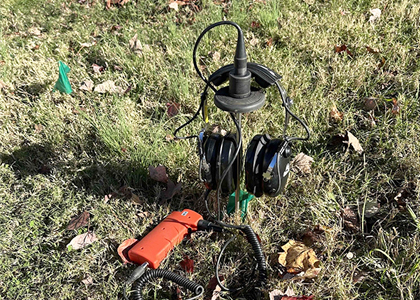
Where supply lines run beneath concrete, non-invasive electronic sensing avoids exploratory demolition. In a related Matthews, North Carolina project, electronic acoustic and sonar wave sensors pinpointed a hot-water line rupture beneath 4 inches of concrete, and the fault was bypassed with precision wall repiping over a two-business-day duration without altering the home's architecture.
Mixed portfolios that also run commercial and residential sites
The same provider scope extends to single-family homeowners and commercial clients, which simplifies vendor management for operators holding both asset types.
Comparison Table: Detection and Diagnostic Methods by Application Role
The table below compares method families using published capability descriptions and the findings recorded in this project. It is a scope-selection reference, not a performance ranking.
| Method family | Documented capability or basis | Practical role in a 20-unit building |
|---|---|---|
| Acoustic / electronic (sonar) sensing | Acoustic sensors are the most common detection method for leaks in pressurized pipes; in-pipe devices using acoustic, pressure, or electromagnetic sensors can be run as a one-time vendor service. | Locating hidden and concealed supply leaks behind walls and beneath slabs without exploratory demolition. |
| Noise loggers | Loggers can be attached magnetically along the distribution system and left in place for extended periods or moved as needed to record noise levels and detect leaks. | Extended monitoring across long shared runs where a single overnight visit may not capture an intermittent leak. |
| Ground penetrating radar / subsurface sensing | Reported capability to detect relatively small water leaks up to 12 feet below the ground surface. | Assessing underground lines that pass beneath driveways, parking areas, or landscaped zones. |
| In-pipe and camera inspection | In-pipe detection devices can be run through pipes as a vendor service; this project used HD sewer endoscopic cameras to map root and grease density in the main lateral. | Confirming the actual internal condition of a drainage lateral before and after clearing. |
| Hydro jetting with camera re-verification | In this project, high-velocity internal hydro jetting and targeted structural repiping were followed by a secondary camera verification sweep. | Restoring full flow and proving the result on record rather than by assumption. |
Two limits are worth stating plainly. Published method comparisons are not performance-normalized benchmarks, and no single method replaces visual confirmation of the pipe interior. Where a drainage lateral is involved, the camera record is the evidence that survives staff turnover.
"We spent months paying local guys to snake these lines over and over, and nothing worked. Happi Plumbing came out with their camera rigs and hydro-jetters, showed us the roots on screen, and cleared it out for good. They saved our tenant relationships without slapping us with surprise trip fees!" — client feedback recorded for the Elite Complexes Main Sewer & Infrastructure Restorative Project.
Delivery Mode and Tenant Satisfaction Objectives
Detection in an occupied building is a logistics exercise as much as a technical one. Delivery in this project was on-site field execution with proactive aftercare engagement, sequenced so that access routes and parking pavement were protected before equipment entered the property. Emergency availability is stated as 24/7/365 on-call coverage, with risk-free transparent estimations and a stated flat No Trip Fee policy.
The tenant satisfaction objective is measurable rather than rhetorical: complete full-capacity pipe flow restoration, avoided early-termination claims, and a significant reduction in recurring emergency drainage call-out costs year over year. The operational objective is equally concrete — 100% obstruction clearance and zero municipal penalties.
Frequently Asked Questions
What licenses and credentials should a property manager verify before hiring a leak detection provider in the Carolinas?
Verify state plumbing licensure, accreditation, and insurance before scope is discussed. Happi Plumbing holds Master Plumber licenses in North Carolina (#L.36297) and South Carolina (#CLM.117404), is a BBB Accredited Business with an A+ rating, and carries a business liability insurance certificate. Also ask whether the provider issues written deliverables — this project closed with post-remediation HD camera footage logs and itemized structural engineering warranty sign-offs rather than a verbal summary.
Can camera and sonar methods actually locate a failure under a driveway or slab in a multifamily building?
Yes, within the limits of the method used. In this project, HD sewer endoscopic cameras traced the internal baseline and confirmed that root intrusion, grease, and organic accumulation had closed the main underground lateral, while broken connections under the driveway were permanently repiped. In the Matthews sub-slab case, electronic acoustic and sonar wave sensors pinpointed a hot-water line rupture beneath 4 inches of concrete. Ground penetrating radar is separately reported to detect relatively small water leaks up to 12 feet below the ground surface, which is relevant when the line sits under paving.
What drives the scope and cost of a leak detection project in a 20-unit building?
Four variables dominate: whether the fault is an obstruction or a concealed supply leak, how deep and how accessible the line is, how much surface protection the site requires during work, and whether verification documentation is included at both the start and the end. A provider that prices only the clearing visit is not pricing the detection work. Ask for an itemized upfront estimate with surcharges and trip fees stated in writing — this project was quoted that way before crews mobilized.
How is the work delivered in an occupied building, and what happens afterward?
Delivery is on-site field execution staged around tenant access, with proactive aftercare engagement after completion. In this 20-unit project, the aftercare layer included a customized property preventative maintenance operations blueprint, a preventative grease disposal routine for the tenant portfolio, and enrollment in an automated follow-up loop. Emergency coverage is stated as 24/7/365 on-call availability.
How quickly can a multifamily operator get an assessment, and how is a next step requested?
Happi Plumbing Corporation operates Monday through Sunday across the Greater Charlotte area and offers free on-site estimates, with scheduling through the 24/7 hotline at 704-448-6884, the web booking portal at happiplumbing.com, or service@happiplumbing.com. For a 20-unit property, the practical first step is a camera-based assessment of the shared lateral, because that single record determines whether the building needs a maintenance routine or a corrective project.
Conclusion
Water leak detection in a 20-unit building succeeds or fails on one question: does the provider document the pipe interior before and after the work? The Elite Complexes project shows what the disciplined version looks like — endoscopic camera tracking to establish the baseline, high-velocity hydro jetting paired with structural repiping where connections had failed, a secondary camera verification sweep, and a preventative maintenance blueprint that keeps the building out of the emergency queue.
For property management and multifamily housing operators, the takeaway is a scoping standard rather than a slogan: verify licensure and insurance, insist on camera evidence at both ends of the job, protect tenant access during execution, and require written deliverables you can hand to the next manager. Everything else — method selection, equipment, schedule — follows from those four checks.
Next Step for Property Managers
Happi Plumbing Corporation provides water leak detection, underground and concealed leak location, drainage diagnostics, and emergency plumbing response across the Greater Charlotte Metropolitan area, including Matthews and Waxhaw, NC. Contact the team at 704-448-6884, email service@happiplumbing.com, or visit www.happiplumbing.com to request a free on-site estimate for a multi-unit property.
Have Questions or Need More Details?
Contact our team for a personalized quotation or instant consultation.
Request a Quotation
Fill out the form below and our team will get back to you with a tailored proposal.
WhatsApp Direct Chat
Prefer to chat in real-time? Message us on WhatsApp for instant assistance & quick answers.
- Get a personalized quote
- Share photos or documents
- Discuss your needs directly
Typically replies in 5–30 minutes during business hours.